
Witnessed cremation in Australia: What it is, What happens and How to decide.
What is a witnessed cremation?
Witnessed cremations are a choice.
For some, it is a deep spiritual and cultural practice, and often it’s something most can’t even imagine. It is, however, one of many choices in after-death care - one you may not know about, be offered, or know how to decide about.
In Australia, a witnessed cremation means being present at the crematorium when the coffin is placed into the cremator. It does not mean witnessing the entire cremation.
My experience comes from working as a Funeral Director in Victoria, where crematoriums are not privately owned, but in other States, they can be.
In metropolitan Melbourne, Cemetery Trusts such as Springvale Botanic Cemetery, Bunurong, Fawkner, and Altona Memorial Park have purpose-built ‘witnessing rooms’ adjacent to the cremators. They are small spaces with a glass viewing window, designed for an intimate group rather than a larger gathering like a funeral.
This is an image from the Southern Metropolitan Cemetery Trust website showing the Springvale witnessing room. You will find that regional crematoriums are not likely to have this kind of resourcing, however discuss with the crematorium or funeral director how they facilitate a witness cremation.
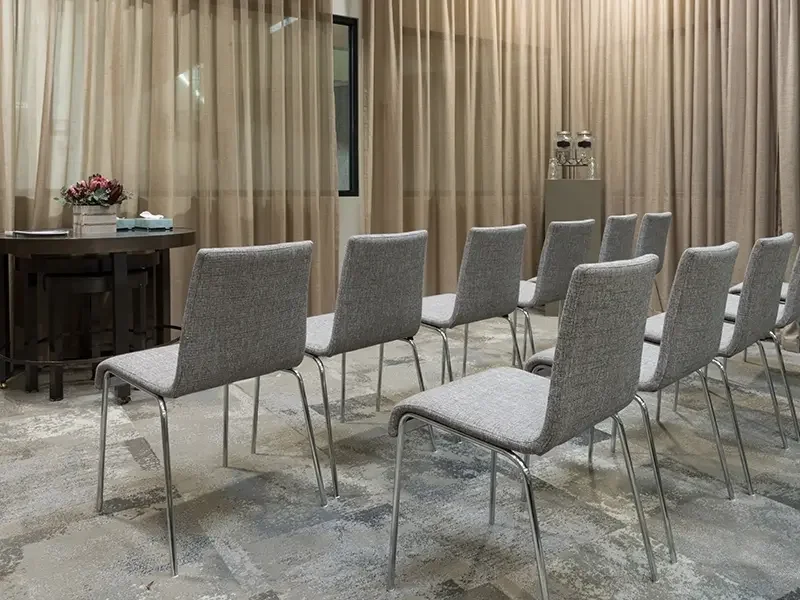
Witnessing Room at Springvale Botanical Cemetery - SMCT
What Happens during a witness cremation?
A witnessed cremation usually needs to be arranged in advance and involves an additional cemetery fee. This allows for time, staffing, and access to a cremator, as the process means that it may briefly stop other cremations from happening at the same time.
On arrival, you are brought into the witnessing room adjacent to the cremation area, with a glass wall or window. Whilst the chapels and garden spaces are thoughtfully designed, the crematorium is an industrial working space - staff are likely to be in high-visibility clothing and personal protective equipment. The witnessing rooms, however, aim to offer a comforting space.
The coffin will be resting on a large trolley with rollers once the paperwork is complete. You may notice that the nameplate on the coffin has been removed – this is placed next to or near the cremator to ensure identification is maintained throughout the process.
You will usually be accompanied by a funeral director, or not if you are choosing to make your own arrangements. Once you are ready, confirm with the funeral director or the crematorium operator, that they can begin moving your person for cremation.
The cremator opens as a metal door slides up. Inside, you will see a chamber that radiates heat, often with a soft glow. Occasionally, small flames may be visible. The coffin is then automatically rolled along the trolley and pushed into the cremator. This happens quickly. As soon as the coffin is fully inside, the door closes automatically. People often comment on how quickly it all happens.
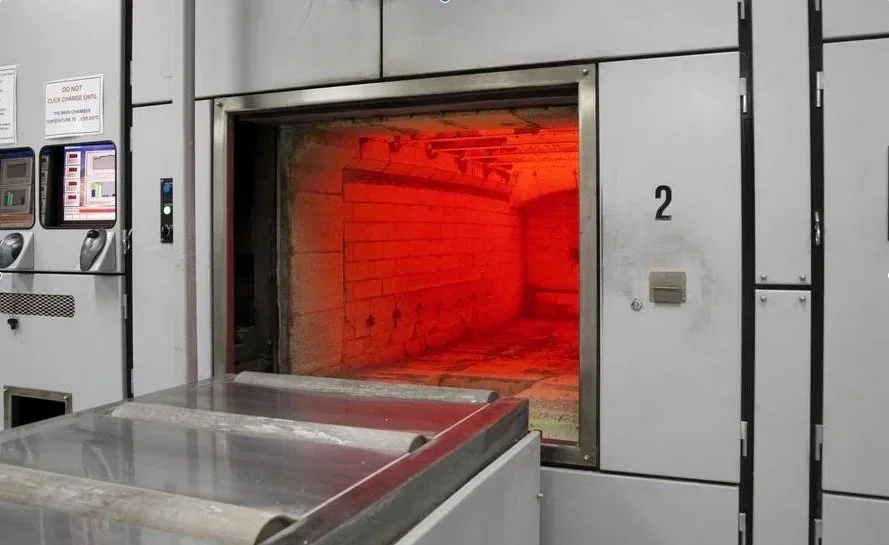
Image by Keri Megelus. Click on the image to go to article.
Depending on the equipment, you may hear a brief “bang” as the coffin transfers from the trolley into the cremator. This can be surprising if you are not expecting it. It is simply a result of the coffin and the trolley not being equal height, and the coffin drops onto the brickwork in the base of the cremator — not a sign that anything has gone wrong.
In some cases, particularly with certain materials (such as lacquered coffins, wicker, fabric, paper or flowers), a small part of the coffin may catch alight as it enters. This is more likely for a shrouded cremation as well. This is also normal, and if prepared, is not likely to be distressing. The witnessing process is over very quickly. The bookings for a witness cremation reflect this, as they are usually only for 15 minutes.
Given my experience, it would be remiss of me not to write about infant cremations. Infant cremations are handled differently due to size. The coffin is usually placed by hand by the operator or placed on a tray before entering the cremator. For safety, the operator will be wearing long fire-retardant gloves or will use a metal device. This is always done with great care and reverence.
Fawkner Memorial Park crematorium in Melbourne was renovated not long ago, and they have installed a button that allows the family to control the timing. When pressed, it activates the automatic opening and placement of the coffin into the cremator.
How do I decide if it’s right for me?
There isn’t a right or wrong way to do this. With information and time, I have seen many people make this decision, though most people choose not to.
I know it to be a very intimate and personal decision. I have seen couples where one parent needs to witness a cremation and the other cannot. One sibling needs to be with their parent right to the end, another does not. A person decides to witness the cremation of their friend but not their parent. That is all okay.
For some, witnessing the cremation creates a sense of completion—a final act of care. This can be especially meaningful for those who have been closely involved in caring for someone at the end of life. I remember a person saying they had accompanied their friend to all their surgeries in their illness, and this felt like the right thing to do – to accompany them to their cremation.
A friend and colleague, Eliza, chose to witness her father’s cremation. When I asked for her reflections, she described it simply:
“It just felt right.”
She had spent years caring for her father and felt a need to see things through to the very end.
“I had loved Dad all my life and had been loved by him, so I wanted to support him through that final act.”
Although initially unsure, she woke early on the day of the cremation with clarity about her decision.
“I also didn’t want him to be on his own, as strange as that may sound.”
On the day, she and her siblings stood together, held hands, and watched as their father’s coffin entered the cremator.
What surprised her was how quick and abrupt the moment felt, and the brief visibility of flames as the door closed—details she had not been prepared for.
Even so, she has no regrets.
“I wanted to see it through to the end… knowing this was the final goodbye. I wanted that for me and for him.”
One of the most important parts of this decision is understanding what the experience will actually be like.
Without that knowledge, unexpected elements—the speed, the sound, the visual intensity—can feel distressing or jarring. When people are prepared, those same elements are more easily understood as part of the process, rather than something alarming.
This is why it’s essential that funeral professionals offer the option of a witnessed cremation, rather than deciding on behalf of people whether it is “too much”.
People are capable of making their own informed choices, even in grief—especially when they are given clear, compassionate information and time.
There is no right choice, only an informed one.
Things to consider when deciding about a witnessed cremation:
Witnessed cremations must be arranged in advance
They incur an additional fee and availability is limited each day
Changing your mind on the day to have a witness cremation may require rescheduling and additional cost.
Sometimes families will book the witness cremation as they are unsure and then choose NOT to do it, knowing that for a few hundred dollars they can make whatever decision they need to in the moment.
If you are a funeral professional/ death worker:
· Avoid making your own judgement call on whether to offer a witness cremation.
· A young adult whose parent has died by suicide CAN choose a witness cremation, a parent MAY want to witness their baby’s cremation. Acknowledge your own discomfort in this space, but do not put it on to families.
· I can offer support on how to have difficult conversations, reach out here.